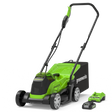
At 2.33 kg, what 'small leaf blower' should mean in daily use
Weight makes a noticeable difference when a blower is mainly used for short jobs.
At 2.33 kg, the G40AB is straightforward to carry around the garden. The cushioned grip and balanced layout also suit jobs where you are using the blower in shorter bursts rather than working continuously for a long period. You might use it to clear leaves from the steps, tidy around the car or blow cut grass away from a path after mowing.
For these jobs, convenience matters. If a blower is easy to grab, you are more likely to use it while there is still only a small amount of debris to clear. A larger machine may make more sense for long clearing routes or heavy autumn leaf fall, but that is a different type of job.
This version is supplied as a tool only. If you want the same 40V blower with a battery included, the 40V 2Ah battery version is the direct alternative. Your existing battery platform may also affect the choice. For users already on Greenworks 24V, the 24V Gen II compact blower is another option.
177 km/h and 11.05 m³/min on a broad carpet of light leaves
A small blower still needs enough airflow to clear more than a few scattered leaves.
The G40AB combines an air speed of 177 km/h with 11.05 m³/min of air volume. When clearing a wider layer of dry leaves, it usually makes more sense to use steady sweeping passes rather than aiming at individual leaves. Work across the edge of the debris and gradually move the whole layer towards one side of the lawn or driveway.
Air volume is useful here because dry leaves often need a broad flow of moving air rather than one concentrated blast. The 177 km/h air speed helps get the material moving, while the airflow supports a wider clearing area.
Dry leaves, grass clippings and other light garden debris are the jobs that best suit this type of blower. Wet or compacted leaves are more demanding. If that is what you regularly need to clear, the higher-output 48V blower/vacuum is a more useful comparison.
If you prefer the 24V battery platform and want a kit rather than a tool-only model, the 24V blower with a 4Ah battery is another option for regular light clearing.
Variable speed on patios, driveways and garden edges
Full power is not useful on every surface.
A stronger setting can clear a strip of dry leaves quickly on an open driveway. Around gravel, plant pots or borders, however, too much airflow can start moving stones, loose soil or leaves that you have already gathered into place.
Variable speed allows you to reduce the airflow in these areas. Use enough power to move the debris, then increase it when necessary. Lower settings give you more control around loose or delicate surfaces, while higher output is there for material that needs more force.
Cruise control is useful in a slightly different way. Once you have found a suitable setting for a longer stretch of paving or lawn, it can maintain that airflow without requiring constant trigger adjustment. On a straightforward clearing job, that makes it easier to keep a steady pace.
There is little benefit in using maximum power everywhere. The better setting is the one that moves the leaves where you want them without blowing them straight into another part of the garden.
When control and low weight matter more than peak output
The G40AB makes the most sense for small, regular clearing jobs.
It suits dry leaves, grass clippings and light debris on lawns, paths, patios and driveways. The combination of low weight and adjustable airflow is particularly useful if you expect to take the blower out several times a week for short periods.
For dense wet leaves, very long clearing routes or jobs where you also want to collect the debris, another format may be more suitable. A blower/vacuum such as the 48V blower/vacuum option adds a collection function that the G40AB does not offer. Higher-output machines are also more appropriate when difficult debris is part of the normal workload rather than an occasional problem.
Choosing the right size of blower is not simply about finding the highest possible air speed. More powerful models can come with different batteries, handling characteristics and tool formats. For many small-to-medium garden jobs, a lighter blower with enough airflow and good control can be the more practical choice.